

← Terug naar blog
RAGAPIslive dataagents
Give Your Chatbot Access to Real-Time Business Data
door Paul Lange | Agent.nl
RAG links LLMs to live data and policies so ecommerce/SaaS chats stay current and can act. No-code RAG deploys in days; transactional bots enable actions but cost more upfront. Maintenance 15–25%/yr. Real-world: Klarna, LinkedIn, DoorDash, RBC. Which first? #AI #RAG
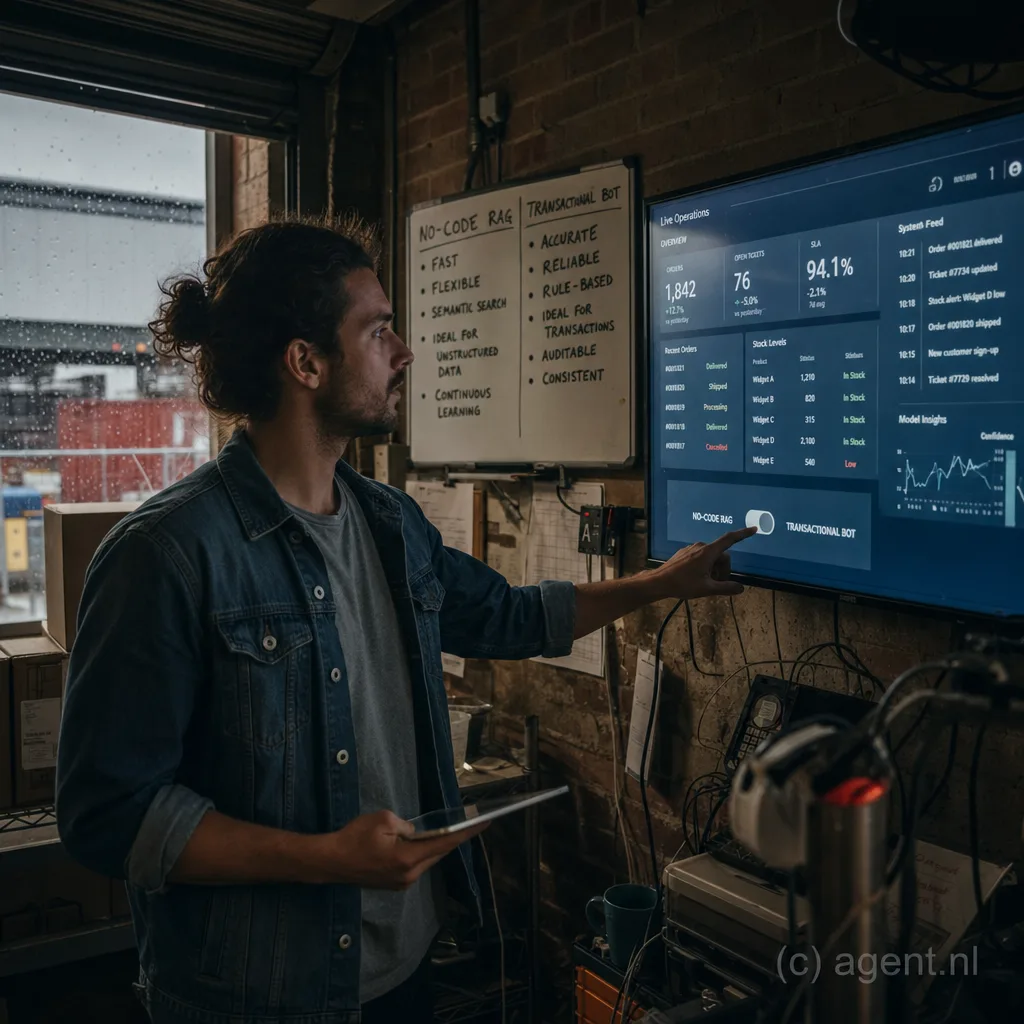
If your chatbot can't access live data, it's not a real AI agent. Retrieval-Augmented Generation links LLMs to external sources and live APIs so answers stay current, grounded in your policies, stock, and orders, not just training data. For ecommerce and SaaS, this means customers get up to date information in one chat and agents can act when needed.
The business case is compelling. No-code RAG platforms let teams go live in a day, while a custom pipeline can take months. Klarna’s RAG assistant reportedly did the work of 700 agents in its first month and is projected to add about $40M in profit. This is the kind of impact no-code tools promise at speed. (https://wonderchat.io/blog/real-world-rag-chatbots)
When you need actions, a transactional bot connected to live systems can check orders, track stock, create tickets, or handle bookings. Yes, it costs more upfront, but you gain real time control and fewer manual handoffs. (https://www.rorixtech.com/blogs/software/ai-chatbot-development-cost)
Cost and ownership matter. A RAG knowledge base chatbot costs roughly $15,000 to $120,000 over 4 to 20 weeks, while a transactional bot runs about $40,000 to $150,000+ over 10 to 18 weeks. At scale, SaaS may look cheaper early, but at 10,000 conversations a three year SaaS plan can reach around $213,840 versus about $118,200 for a custom RAG solution. (https://www.rorixtech.com/blogs/software/ai-chatbot-development-cost)
Maintenance is real too. Expect ongoing costs around 15% to 25% of the original build cost per year for prompt updates, API fixes and model testing. (https://www.rorixtech.com/blogs/software/ai-chatbot-development-cost)
Real world adoption spans ecommerce and fintech players like Klarna, LinkedIn, DoorDash, Grab and RBC to cut manual effort and lift profit. The takeaway: you can deploy quickly with no code or tailor a robust live data solution, but you should plan for ongoing upkeep. (https://wonderchat.io/blog/real-world-rag-chatbots)
If you’re building for ecommerce or SaaS, what would you deploy first to unlock real time value for your customers: a no-code RAG chat that fetches policies and stock, or a transactional bot that can actually take actions in your systems? What steps will you take to ensure accuracy, security, and smooth handoffs? #AI #RAG #Chatbot #LiveData #Ecommerce #SaaS